Awe smolt tracking project (2023-2026)
Following the completion of the West coast Smolt Tracking Project, AFT utilised its newly earnt skills to investigate the movement of salmon smolts emerging from the main spawning tributary, the River Orchy, through Loch Awe and the River Awe into the sea (Loch Etive). The main aims of the study are to ensure the maximum survival of smolts as they pass two hydroelectric generation schemes: Cruachan pump storage hydro scheme (Loch Awe) and the Inverawe Hydroelectric scheme (River Awe).

The Awe Barrage located at the outflow of Loch Awe
Between 2023 and 2025, AFT have utilised acoustic tracking techniques to study the movement of 304 smolts trapped at Dalmally on the River Orchy which are detected by an array of receivers deployed along their migration route. The results to date have shown variation in the percentage of tagged smolts reaching the River Awe barrage at the outflow of Loch Awe (41-92 % depending on their release site) and eventually to the estuary (46-85 % of those smolts that reached the barrage).
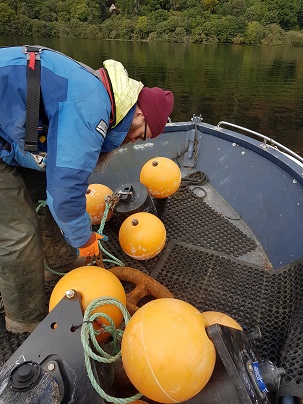
Deploying acoustic receivers in Loch Awe
The main influences on the passage of smolts, to date, appear to be the environmental conditions (influencing flow rates) and the management of the way that the compensation flow is provided to the River Awe. Further work in 2026 is aimed at increasing the sample size of tagged smolts and learning more about smolt passage through the Pass of Brander (Cruachan pump storage hydro scheme) and the optimal conditions for the passage of smolts at the Awe barrage.
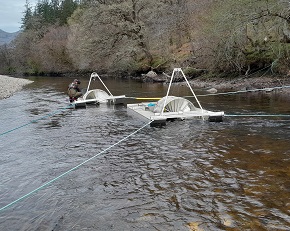
Rotary screw traps catching salmon smolts in the River Orchy
The cost of the project is considerable (£50-65,000 per year) which has been generously supported by Scottish & Southern Energy, the Drax Group, Mowi Scotland, with support from Atlantic Salmon Trust for the loan of their acoustic receivers, Glasgow University for guidance on the project design and their Home Office Project License and the Marine Directorate for the loan of their Rotary Screw trap.